Friday, 14 January 2011
The time over Christmas I spent on my work mainly consisted of getting used to using Final cut as an editing program rather than i-movie. I found myself spending unnecessarily long periods of time trying to work out how to achieve seemingly simple effects such as - making My various films black and white and removing and editing sound. Final cut frustrated me. Not only how complicated film editing had become in comparison to the previous program but also the fact that I'd willingly spent 60 odd quid on the program and that it had slowed down my laptop a considerable amount! After a good 2 hour session trying to make sense of you-tube tutorials with no luck I began to write a list of all the problems I had encountered (in my new lovely moleskin notebook.) On the Monday I got back to uni I went straight to the Mac suite and asked the technicians to go through my list of problems. What it taught me about my own work process is that I need to be more open to learning new skills and also be open to the fact that new skills take time and focus to perfect. Ive realised how I need to exploit the very readily available help and support available at uni whilst I still can and to not be afraid to ask for help. It also taught me that Macs are not as seamless and perfect as they claim to be!

Friday, 10 December 2010
Post Review
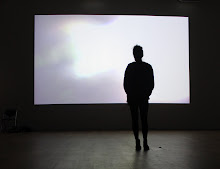
The previous few weeks have consisted of fighting with projectors and DVD writing programs with the intention of creating a very specific piece of video art. Although I feel my assessment went well there were a few limitations I came across whilst working with the space and projectors that stopped me from achieving exactly what I wanted. So overall a rather stressful experience. After the assessment last Wednesday along with a slight feeling of disappointment I naturally felt a huge sense of relief that it was over. I jumped on a train to Manchester to visit a friend with the intention of giving my brain a creative break, however during the 50 minute journey I found myself scrawling in my notebook frantically writing down all the feed back and advice I'd been given during the assessment. It made me realise how I'm constantly thinking in a creative way (however it's not always productive creativity.)


 Amongst the frantic scrawl I've managed to extract a series of bullet points that explain my plan of action over the Christmas break.


- To capture a huge file of film to work with
- To concentrate on experimenting with editing film using Final Cut
- Look in to buying a second hand projector
- Experiment with filming underwater
- Look at the work of wide range of film artist particularly older, more primitive techniques.
Tuesday, 7 December 2010
Biennial review
My involvement with the Biennial has been mainly that of a spectator however due to the nature of my degree I have managed to get an brief insight in to how the Biennial was curated and how much dedication and time went in to the process.
Looking back over my Blog entries based on my Biennial experiences over that last few months has made me think about the talk given to us by Lorenzo at the very beginning. As I have experienced more of the Biennial the information given to us by Lorenzo has begun to make more sense and become very real. I recall something Lorenzo said in the talk about the importance of communication in organizing such a monumental event. When being involved in pieces such as the Allan Kaprow reenactment and Sachiko Abe piece it was very apparent how the quality of dialogue between curator and artist could potentially make of break an art work (especially a performance piece.) If there is a lack of understanding between curator and artist the piece would simply not work. It also made me realise that being involved with the curatorial side of contemporary art is something I would be good at.
For me I feel that this years Biennial has been far more successful than 'made up' in 2008. This is mainly due to my involvement in this years biennial however I also think the theme was far more successful and gave far more for the artists to work with.
The theme of 'Touched' and its multiple and equally valid meanings have been addressed and made clearer in my own mind due to my engagement with the artists individual representations. At the end of last year we were given a brief to follow that involved creating a piece of art work that we would want to submit into the 2010 Biennial. My idea was instantly to concentrate on touched in the physical and sexual sense. I went on to develop a series of very abstract, very physical black and white photographs that described physical touch.

After experiencing the Biennial that my piece was hypothetically intending to be a part of it made me realise how completely unsuitable my piece would have been for display. If the Biennial has taught me anything about being a practicing fine artist it is to never take a brief too literally and to always think completely outside of the obvious. The theme was tackled in a number of ways. Franz West explored the theme physically with his touchable sculpture 'smears' .Ryan Trecartin made the saying to be "touched in the head" very real with his terrifying films. Lee Mingwei explored the theme in terms of emotion. I believe that the most successful pieces were those that appealed to my inner most emotions and fears. The works that touched me the most such as those by Sashico Abe, Lee Ming Wei and Teching Hseih made me feel anxious,uncomfortable, isolated, guilty and inspired.
Monday, 6 December 2010
Time to reflect
The end of the Biennial has come as a bit of a shock, although I feel I got a lot out of it there were a few exhibitions that I didn't get round to visiting and I feel slightly guilty for not exploiting the opportunity more. Liverpool is a very different place without the permanent availability of art on my doorstep and it will be missed!
There were a couple of pieces that I didn't get round to writing about that have effected my practice in a significant way. I'm going to use this opportunity to look back and reflect on the pieces I missed out and also to reflect on my Biennial experience as a whole.
Joe Diebes: Scherzo
"A music film that explores the limits of human virtuosity and the convergence of human and machine. The virtuoso's desire to achieve machine-like speed and perfection is realized in both exhilarating and disturbing dimensions as his performance is fragmented and recombined into an impossibly extended musical climax."
The atmosphere achieved by the piece was a perfect combination of melodic repetition and extreme intensity. I found it fascinating how such an overwhelming experience could be created by using a single instrument. For me the sound alone (without the video footage) would have been enough to create the same intensity and although the visuals added an alternative sensory experience I felt they were unnecessary. Although disturbing and uncomfortable to be a part of I couldn't help but to be drawn in to the piece and hypnotized by it. I found myself being very reluctant to leave.
For me the piece was about the constant battle for contemporary artists to maintain a constant relevant contemporary practice and to keep up with ever changing and developing technology. It also said something very significant about Physical and mental endurance and extreme dedication to an individuals fine art practice.
I will consider the use of composed sound in my own work.
http://vimeo.com/15936603
Wannes Goetschalckx: 1 Without
'1 WITHOUT, alludes to the composite of words and meanings within Goetschalckx's spoken language- in Dutch 'wit' means 'white' and 'hout' means 'wood'-while also referencing the 'empty' twelf plinth that forms part of the occasional platform for live interventions by the artist' Frances Loeffler-Liverpool Biennial the guide.
I felt this piece had a very direct connection to my work as it is based on repetitive, ritualistic human behavior. Each wooden box contained a piece of video footage of the the artist carrying out relatively normal tasks within a confined space. The idea of captivity and isolation is emphasized by the artists need to engage in a very particular activity to keep his mind occupied be it eating, pacing, bathing or masturbating.
'1 WITHOUT, alludes to the composite of words and meanings within Goetschalckx's spoken language- in Dutch 'wit' means 'white' and 'hout' means 'wood'-while also referencing the 'empty' twelf plinth that forms part of the occasional platform for live interventions by the artist' Frances Loeffler-Liverpool Biennial the guide.
I felt this piece had a very direct connection to my work as it is based on repetitive, ritualistic human behavior. Each wooden box contained a piece of video footage of the the artist carrying out relatively normal tasks within a confined space. The idea of captivity and isolation is emphasized by the artists need to engage in a very particular activity to keep his mind occupied be it eating, pacing, bathing or masturbating.
The piece gives a very intimate insight into the behavioral patterns of humans, showing the need to keep our minds occupied and stimulated in order to keep sane and content. It shows how we need a reason for existing and its is not enough to simply exist.

Tuesday, 23 November 2010
London in a weekend
Over the weekend I was lucky enough to visit some incredible exhibitions in London. Out of the overwhelming amount of art I saw there were a few pieces in particular that had a lasting impression.
Moved by the South Bank Centre-
The Hayward gallery at the south Bank centre is currently holding an exhibition that celebrates choreography and performance art.
"The main focus of the exhibition is on visual artists, dancers and choreographers who create sculptures and installations that directly affect the movements of exhibition goers, turning spectators in to active participants."(Exhibition guide)
The exhibition is a brilliant way of getting involved in and therefore understanding a bit more about performance as an artistic medium and I would recommend the exhibition to anyone who is interested in working with performance art and installation art.
The first piece we encountered was 'Green light corridor' by Bruce Nauman. As the title suggests the piece involves a very narrow walkway saturated with fluorescent green light. When I first looked at the piece I imagined it impossible to walk through the corridor. However as I entered the narrow corridor I realised that getting from one end to the other was a possible but unpleasant experience. The glare of the light the height of the walls and the narrowness of the space induced a huge amount of unease and claustrophobia. I reached roughly half way and noticed that a child was attempting to walked towards me from the wrong end of piece (even though a sign clearly stated NO ENTRY!) I felt an instant sense of anxiety and was convinced I was going to get trapped!
For the visitor about to enter his corridor work, Nauman has this to say; "You're now a participant in the work. You're very aware as you walk up or down that your body has to make an adjustment at each step. and so you have to figure when you can change your weight and where your foot is going to be placed and how high you step or how far down you step. and nothing is so great that you have to struggle with it, but everything is a little bit of an adjustment so your kept a little off balance all the time, adjusting you're self"

The piece has a very direct connection with my ongoing installation/film project and since participating in the piece I have been thinking about how I would change it to make the experience even more intense.
- I would change the color to a deep red or something equally oppressive.
- I would have walls moving in or appear to be moving in to create various states of anxiety.
- I would make walkway longeror curve the walk way slightly so that the end of it can't be seen therefore emphasizing the feeling of claustrophobia.
Tania Bruguera's installation piece consists of a blacked out room with halogen lamps lined up in a grid on the far wall. On entering the the room you are hit by blindingly bright light and unsettling sounds such as the reloading of gun and whispering aggressive voices. This disorientating experience is followed by total blackness and silence which is very unsettling. The piece has a direct effect on our movement and behavior, causing temporary disorientation and evoking the feeling of captivity, interrogation, torture and surveillance.
Bruguera explains that her intention is "To address the subtlety of and seductiveness of power, and our own participation in the process." She also intends for the viewer to "experience politics as a sensation, experiencing fear, vulnerability and sensory deprivation before eventually achieving awareness."
It was very interesting to experience a piece that evokes the same feeling to one that I am trying to achieve. Viewing the installation has given me the confidence to go ahead with my Idea and made me realise that with the correct equipment and space the piece has potential to be very successful.
Monday, 22 November 2010
Dream chase
In our conscious states we learn to suppress our irrational thoughts and fears in-order to keep sane. However when we dream, our subconscious mind takes over. It allows our inner most fears and anxieties to take control of our thought process. The intention with Dream Chase is to tap in to a subconscious state of anxiety. In the film a figure is being chased. Much like we experience in lucid dreams the sequence is slowed down dramatically showing the figure struggling to escape from an unknown entity. The sound is ambiguous and distorted suggesting the unknown and possibly paranormal. I intend Dream chase to be projected amongst other films and looped to suggest the idea of eternity.
Sunday, 7 November 2010
A sense of Non-place
Essay topic


“The world is getting smaller due to the increasing ability to travel.” Jagjit Chuhan (Lecture 4/10/10 ‘a sense of place’). Cities that once had had very unique distinguishable cultural differences now suffer from a complete loss of identity. European city centres in particular seem to have been developed in to one mass of international shopping arcades and are no longer distinguishable. During a trip to Madrid last year, whilst standing between Zara and H and M on the main high street it became apparent that I could have been anywhere in Europe in fact I could have been Stood on Fargate in the centre of Sheffield. My essay for this semester will be written on how modern and contemporary artists explore the idea of identity and lack of identity of place. Photographer Andreas Gursky bases his work on the anonymous non-place.

"99 Cent", 1999, 207 x 337 cm.

"Ruhrtal", 174 x 223 cm.

"Tokyo Stock Exchange", 1990, 188 x 230 cm.
Subscribe to:
Posts (Atom)